 Marble-Lite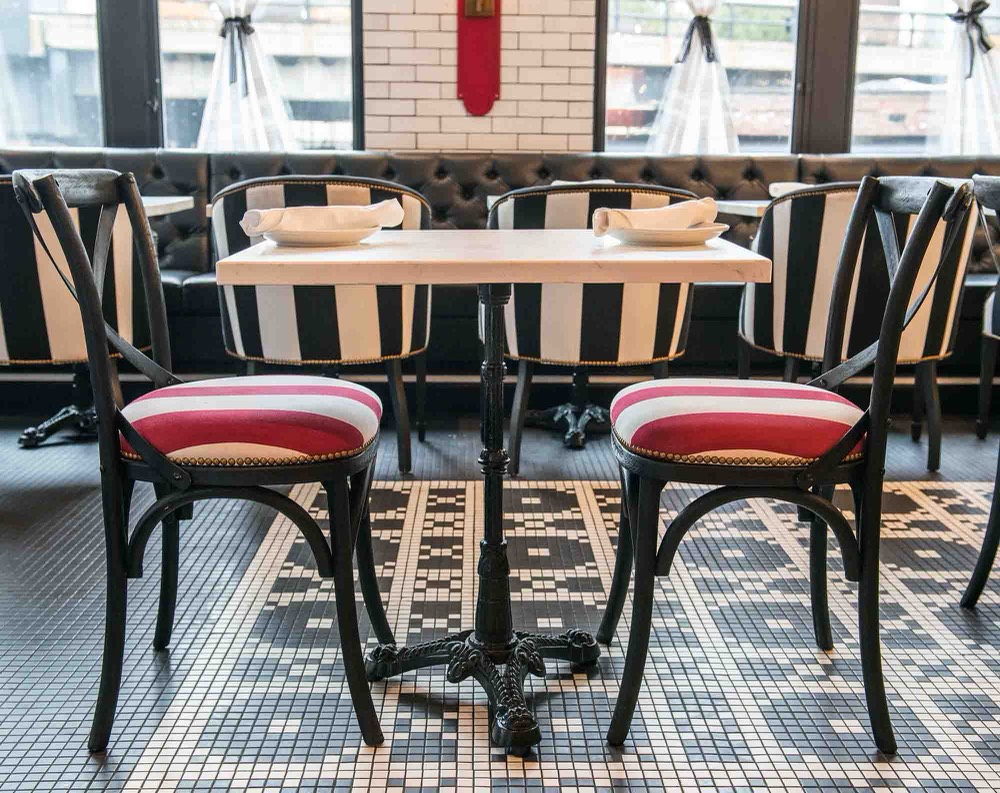
A dining room that turns three hundred covers on a Saturday asks more of its furniture than most people realize. Restaurant table tops get bussed hard, wiped with commercial degreasers, bumped by chair backs, and loaded with hot plates — all day, every day. Spec them well and nobody notices them for a decade. Spec them poorly and you're replacing tops in eighteen months.
We've been making restaurant table tops in Miami since 1978, and the same handful of decisions come up on nearly every project. Here's how to think through each one before you send out your specs.
Start with the seating math, not the table
The single most common mistake is picking a table size first and then trying to make the covers fit. Work the other way. Allow roughly 24 inches of table edge per guest, and figure on 24 to 30 inches of table depth for a comfortable place setting.
In practice that means a 24″ or 30″ round seats two comfortably and four in a pinch; a 36″ round seats four; a 30″ × 48″ rectangle seats four with room for shared plates. If your concept leans toward large parties, rectangles that can be pushed together will serve you far better than a room full of rounds.
Match the shape to how the room actually flows
Rounds are forgiving in tight rooms — no corners to catch a hip or a service tray — and they read as more social. Squares and rectangles seat more people per square foot and combine easily for parties of six or eight. Most successful dining rooms use a mix: rounds along walkways and window lines, rectangles down the banquette.
Because every top we make is poured to order, an odd corner or a curved banquette isn't a problem. Send us a dimension and we'll make the shape that fits it.
The edge profile is a durability decision
Designers tend to pick an edge for the look. In a high-volume room, it's really about impact. The table edge is what takes the chair backs, the bus tubs, and the vacuum cleaner — and a heavier profile gives you more material to absorb all of it.
Our 1¼″ waterfall edge comes standard on stocked sizes and is the workhorse for busy dining rooms. Square edges are available in ¾″, 1¼″, 1½″, and 2″ on any custom size — the ¾″ square gives you a thin, modern line for a lighter-use café, while the 1½″ and 2″ profiles put real mass where the abuse happens.
Confirm the base before you finalize the top
Tops and bases have to be specified together. A base that's too small for the top makes a table that rocks when a guest leans on the edge; too large and it fights with chair legs. As a rule of thumb, the base spread should be about two-thirds the width of the top for rounds, and X-style or twin-column bases carry long rectangles better than a single center column.
Get the base decided early so the whole table is planned as one piece — but attaching it is the easy part. Every top we build has a plywood substrate glued to the underside, so any base fastens straight to the wood, not the marble, and mounts without any issue.
Ask how the surface handles the back-of-house reality
Wine, citrus, coffee, oil, and commercial cleaners all live on a restaurant table. A zero-porosity cultured marble surface doesn't absorb any of them — there's nothing to seal, nothing to re-seal, and no ring left behind by a glass of cabernet. It's heat-resistant and UV-stable too, which matters for covered patios in the Florida sun.
Ask about repairs while you're at it. Minor scratches and light chips can usually be buffed out rather than replaced, and because everything is made to order, replacing one damaged top later doesn't mean re-doing the room.
"The tops that last aren't the fanciest ones. They're the ones where somebody thought about the bus station and the chair backs before they thought about the photograph."
Build the lead time into your schedule
Our standard lead time runs about two to four weeks from order confirmation, manufactured factory-direct from our Miami plant — no overseas port delays. There's no minimum order, so a single-location restaurant ordering a dozen tops gets the same treatment as a group outfitting five rooms. Just reserve production time early; opening dates rarely move to accommodate furniture.
If you're working through a spec now, browse our full range of contract-grade restaurant table tops — then send us your dimensions for a commercial quote, or request a free sample kit so you can put the material in front of your client before you commit.