 Marble-Lite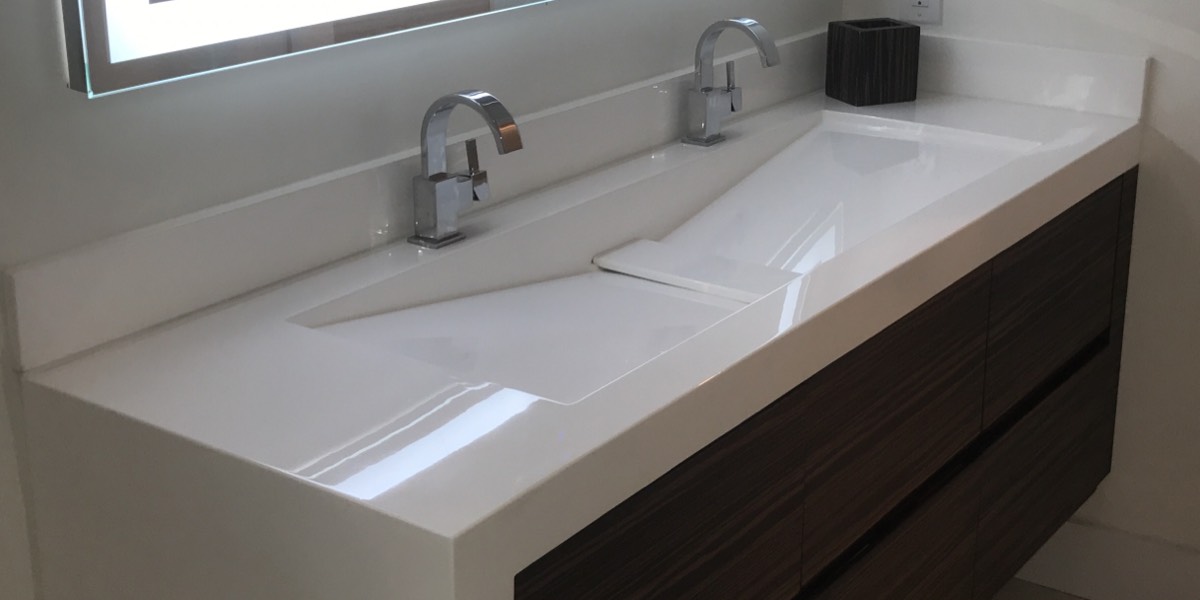
Most bathroom remodels come down to the same three materials. Cultured marble, quartz, and solid surface all photograph beautifully, all resist water, and all get recommended by somebody. The differences that actually matter show up later — at the sink, at the seams, and the first time something goes wrong.
We've been casting cultured marble in Miami since 1978, so we have an obvious favorite. But an honest comparison serves you better than a sales pitch, and each of these three has a job it does best. Here's how they really compare.
What each material actually is
Cultured marble is crushed marble blended with resin, poured into a mold, and finished with a protective gel coat. The key word is mold: the piece is cast to your dimensions rather than cut down from stock, which is why the bowl, the deck, and the integral backsplash can all be one continuous piece.
Quartz is roughly 90% ground natural quartz bound with resin and pressed into large slabs. Those slabs are then cut and fabricated to fit your space — a subtractive process, closer to working with natural stone.
Solid surface is an acrylic or polyester resin filled with mineral powder, also produced as sheets and fabricated to size. Its signature trait is that pieces can be chemically bonded together and sanded flush, making joints very hard to see.
The seam question — the difference you'll live with
This is where a bathroom differs from a kitchen, and it's the point most comparison charts skip.
Because cultured marble is cast, a vanity top and its bowl come out of the mold as a single piece. There's no rim, no clamp, no bead of caulk where the bowl meets the deck — which means there's no seam to discolor, and nothing to re-caulk in three years. The same logic applies to shower walls and pans: full-size panels mean a shower with a handful of joints instead of hundreds of grout lines.
With quartz, the sink is a separate component fastened underneath and sealed with silicone. On a longer double vanity you may also need a slab seam, which is visible on close inspection. Solid surface sits in between — its seams can be made nearly invisible, and integral bowls are available, though they're bonded rather than cast in one pour.
Porosity and everyday maintenance
All three are non-porous, and all three are a genuine improvement over natural stone here. None of them require sealing, and none will absorb toothpaste, hairspray, or soap.
Day to day, cultured marble asks for a soft cloth and mild soap — nothing more. What it doesn't want is abrasive powder or a scouring pad, which will dull the gel coat's shine over time. Quartz has the same aversion to harsh chemicals and abrasives. Solid surface is the most forgiving of scrubbing, precisely because it's meant to be sanded.
Scratches, heat, and what happens when something goes wrong
Quartz is the hardest of the three and shrugs off scratches best. Solid surface is the softest and marks most easily — but it's also the easiest to renew, since a scratch sands out and the repair blends invisibly.
Cultured marble sits comfortably in between for a bathroom's workload, and its gel coat can be buffed and polished if it does pick up a scuff. Deeper damage is repairable in place by a professional, which is worth knowing: a chipped quartz slab edge is a much harder conversation.
Heat deserves a plain answer, because all three are resin-based and all three dislike it. A hot flat iron or curling wand left face-down on any of these surfaces can leave a mark. Set hot tools on a stand or a folded towel and this simply never comes up.
Customization: made-to-order vs. cut-to-fit
Because we cast each piece, the dimensions are yours — an odd wall-to-wall measurement, an off-center bowl location, a shower pan built to a specific opening. Nothing has to be forced into a standard size.
Marble-Lite's edge options are square, offered from the standard ¾" up through 10" for a thicker, more substantial look; bullnose in 1½"; and a 2" stone edge. Backsplashes come two ways: an integral splash cast as part of the top at 4" high, or a separate backsplash — a more modern look — at whatever height suits the room. Side splashes are always separate pieces.
The bowls are where cast construction really pulls ahead. Alongside the classic square and rectangular shapes, our sculpted bowls — the Ramp series, Wave, Slant, Hexagonal, and Plasma — are shapes that can only exist because the bowl is formed in a mold rather than carved from a slab. With quartz or solid surface you're generally choosing a sink to install into the top, not a shape that flows out of it.
So which one should you choose?
Choose quartz for a kitchen island, a bar, or anywhere a surface takes knives and heavy daily wear — that's the material's home turf, and it earns it.
Choose solid surface when you want a long, uninterrupted matte run with joints you can't find, and you like knowing the surface can be sanded fresh years from now.
Choose cultured marble for the bathroom. A one-piece top and bowl with nothing to re-caulk, shower walls and pans without grout, color and veining matched to your room, and every dimension made to order — that combination is hard to assemble any other way.
"People come to us comparing spec sheets. What usually decides it is standing in front of a vanity top and realizing there's no seam around the bowl."
Explore our vanity tops, shower walls and pans, and tubs — or request a free sample kit and compare the finish in your own bathroom light, next to your own cabinets. It's the fastest way to settle the question.