 Marble-Lite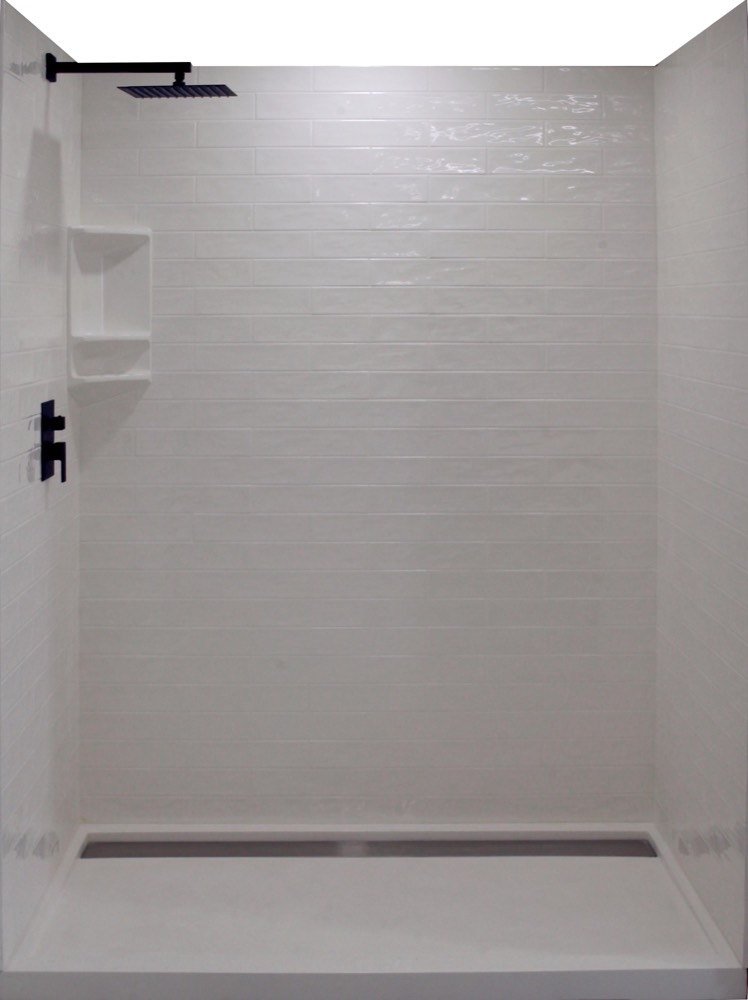
The shower floor is the hardest-working surface in a bathroom. It takes standing water every single day, it carries the full weight of whoever is standing on it, and it's the one place where a small failure turns into a very expensive repair. So the choice between a cultured marble shower pan and a tiled shower floor deserves more thought than it usually gets.
Both can look beautiful on install day. What separates them is how they're built underneath — and how they behave in year five, year ten, and year twenty.
How each one is actually built
A tiled shower floor isn't really a floor. It's an assembly: a sloped mortar bed, a waterproof membrane or pan liner, a second mortar bed on top, then thinset, then tile, then grout. Every layer has to be built correctly on-site, in your bathroom, usually over several days. Done well, it works. Done in a hurry, it's a slow leak with a tile finish on it.
A cultured marble shower pan is one solid piece. We pour it in Hialeah Gardens to the exact dimensions of your opening, with the slope to the drain already molded in, and it bonds directly to a sound, level subfloor. There's no liner, no mud bed, and no grout joints in the floor at all — because there's nothing to joint. The waterproofing isn't a layer under the surface; it is the surface.
Where tile shower floors usually fail
Grout is porous. It absorbs water, it stains, it darkens in the corners, and eventually it cracks — most often along the perimeter where the floor meets the wall, because that joint moves as the house moves. Once water gets past the grout, it's relying entirely on the membrane below, which nobody can inspect without demolition.
That's the real problem with a tiled floor: you can't see the part that matters. A tile shower can look perfectly fine while the pan liner underneath has been failing for two years. By the time it shows up as a stain on the ceiling below or a soft spot in the subfloor, the repair is a full tear-out.
A one-piece pan removes that entire category of risk. There's no hidden layer doing the waterproofing, no seam in the floor, and nothing to reseal on a schedule.
Cleaning and mold
Cultured marble is zero-porosity — the gel coat surface doesn't absorb moisture, so the conditions mold needs simply aren't there. A soft cloth and mild soap is genuinely the whole maintenance routine. No sealing, no grout brush, no bleach pens along the corners.
Anyone who has owned a tiled shower knows the alternative: scrubbing grout lines, re-sealing every year or two, and eventually accepting that the grout will never look new again. It's not a knock on tile as a material. It's just what happens when you put something porous where the water sits.
Slip resistance
This is one place where people assume tile wins, and it doesn't have to. Every shower pan we make comes with a nonslip textured floor as standard — it's molded right into the surface, not a coating applied afterward, so it can't wear off or peel. That includes walk-in and accessible showers, where footing matters most.
Installation time
A built-up tile pan is a multi-day job with cure times between steps. A cultured marble pan is set in a fraction of that — it arrives pre-sloped and watertight, so the installer is placing a finished floor rather than building one. If you're renovating a home's only bathroom, that difference is measured in days your family doesn't have a shower.
Fit, drains and design
Made-to-order means the pan matches your opening instead of the other way around. Straight or corner, low-profile for a barely-there threshold, or curbed if you want the traditional raised lip. The drain goes where your plumbing already is — center or offset — and we pour the slope to match that location. Round, square and linear trench drains are all on the table.
Because the pan, the wall panels and the accessories are molded from the same material in the same color, a Carrara White pan matches Carrara White walls exactly — something that's difficult to pull off when you're sourcing floor tile and wall tile separately.
When tile still makes sense
We'll be straight with you: if you want an intricate mosaic pattern, a specific artisan tile, or a fully curbless floor that pitches across an entire wet room, tile does things a molded pan doesn't. Some designs are worth the maintenance. Just go in knowing what you're signing up for — the grout, the sealing, and the membrane you can't inspect.
How to decide
Ask yourself two questions. First: how much upkeep do you actually want to do? If the honest answer is "none," that points at a pan. Second: is this shower being used hard — kids, guests, a rental, a primary bath used twice a day? The harder it works, the more a single watertight piece is worth.
"We've been pouring shower pans since 1978. The ones we made in the eighties are still in service — because there was never a grout joint in them to fail."
Send us your opening dimensions and drain location and we'll build to it. Explore our shower pans and matching wall panels, or design yours in the shower pan builder and watch it draw live.